
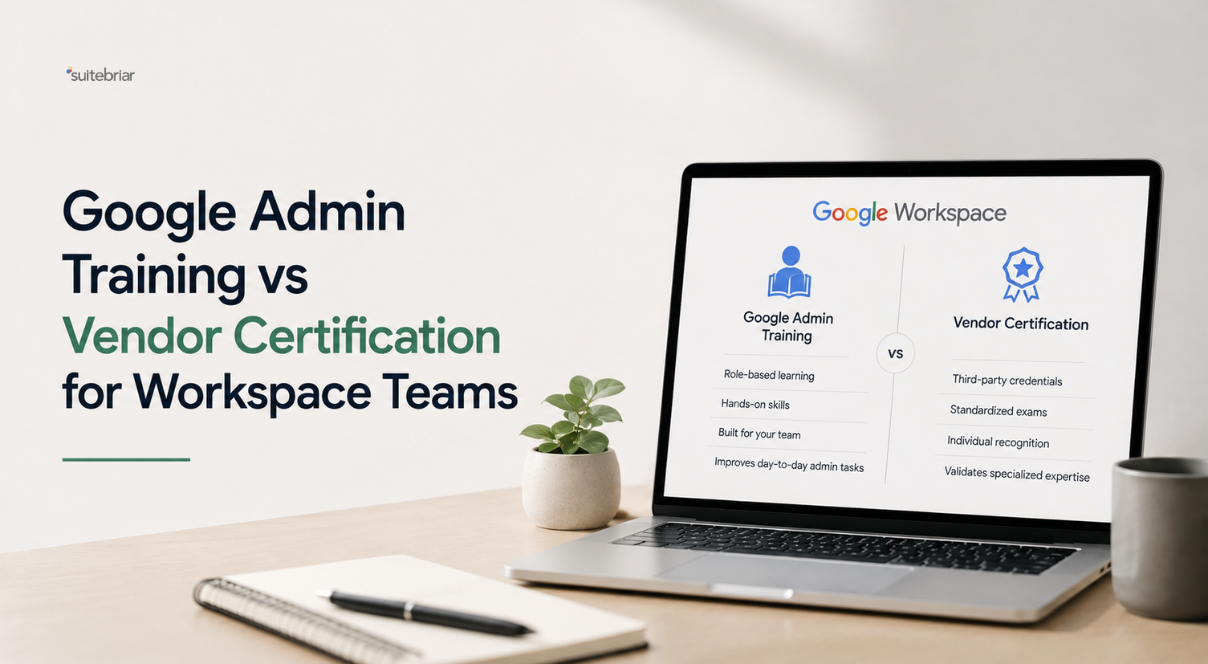
Google Admin Training vs Vendor Certification for Workspace Teams


The Real Decision Behind Google Admin Training
IT leaders filling a Workspace admin seat face a fork that looks simple on paper but plays out differently depending on the organization. One path is vendor certification: a structured, exam-oriented program that produces a portable credential. The other is internal enablement: role-based learning tied to the organization's own admin console, policies, and deployment stage. Both paths teach the admin console, but they optimize for different outcomes. Certification builds a standardized knowledge baseline and proves it to future employers. Enablement builds operational fluency in the environment the admin actually has to manage.
Choosing the wrong path doesn't mean the admin learns nothing; it means the organization spends weeks or months closing a gap that the other path would have addressed from the start. The comparison that follows uses five criteria IT leaders actually weigh when evaluating Google admin training options: cost, coverage breadth, time to operational effectiveness, credential portability, and fit for the organization's current Workspace maturity.
Comparison Criteria That Actually Matter to IT Leaders
Star ratings and course length are easy to compare but hard to act on. A 4.7-star program can still leave an admin unprepared for the first real DLP incident if the organization's data governance posture wasn't part of the curriculum. The five criteria below were chosen because they map to the decisions IT leaders actually make when budgeting time and money for admin readiness.
Direct and indirect cost, including subscription fees, lost productivity during training, and any partner engagement. Coverage of real admin console tasks versus exam topics, because the two overlap but aren't identical. Time from starting training to handling real tickets independently, which matters more to a hiring manager than hours of video content. Credential portability and employer recognition, which matters most to the individual admin and to organizations that want to attract talent. And alignment with the organization's deployment stage, because an admin preparing for a migration needs different skills than one maintaining a stable environment.
What Vendor Certification Tracks Actually Cover
Two formal paths dominate. The Google Skills learning path for the Associate Google Workspace Administrator Certification is managed by Google Cloud and contains five activities described as a curated collection of on-demand courses, labs, and skill badges. The path promises real-world, hands-on experience with Google Cloud technologies for the Workspace Admin role. What it doesn't publicly clarify is whether those five activities include proctored assessments or skill badges only, a distinction that matters to anyone trying to demonstrate credentials to an employer or client.
The Coursera Google Workspace Administrator Professional Certificate takes a different approach: a five-course series covering user provisioning (Course 1, roughly 5 hours), core services configuration (Course 2, roughly 9 hours), data governance and DLP rules in Gmail (Course 3, roughly 3 hours), security settings including authentication and access controls (Course 4, roughly 6 hours), and troubleshooting common issues like Calendar syncing (Course 5, roughly 4 hours). Skills listed across the program include identity and access management, user provisioning, endpoint security, data loss prevention, and configuration management.
The time estimates on the Coursera page deserve a closer look. The header states four weeks to complete at ten hours per week, which implies roughly 40 hours. The FAQ section states the specialization is designed to be completed in five weeks at approximately five hours per week, which implies roughly 25 hours. Adding up the individual course hours yields about 27 hours of content. The discrepancy isn't catastrophic, but anyone building a training schedule around the 40-hour figure will over-allocate, and anyone relying on the 25-hour figure may under-allocate if they need extra time on the security module. The program is labeled beginner level with no prior experience required, but Course 4 on endpoint security and cloud security policies assumes comfort with concepts that a true beginner will need to learn elsewhere first.
What Internal Enablement Actually Covers
A structured internal enablement program doesn't look like a course catalog. It looks like a set of role-based learning paths, segmented by the jobs people actually do. Google Cloud's own training page organizes Workspace learning into three tracks: Business User, Citizen Developer, and Administrator. That segmentation matters because the admin's job isn't limited to configuring services. In most mid-market organizations, the admin is also the person fielding questions from business users, enabling Gemini features for early adopters, and troubleshooting shared drive permissions at 4 p.m. on a Friday.
Internal enablement built around the live environment typically combines on-demand free resources from Google, partner-led workshops tailored to the organization's policies, and hands-on labs run against the actual admin console rather than a sandbox. The difference is subtle but significant: a lab that teaches DLP rule configuration in a generic environment teaches the concept, while a workshop that configures DLP rules against the organization's real Gmail domain teaches the concept and produces a working policy. Organizations planning Gemini rollouts or generative AI adoption often find that role-based learning paths covering Citizen Developer and generative AI adoption tracks are more immediately useful than certification prep, because the admin needs to understand what users will be doing with those tools before configuring access and governance around them.
Evaluating Both Paths Against the Five Criteria
On cost, the comparison is partially unsettled. No verified pricing was captured from public sources for the Google Skills learning path, and Coursera pricing varies by subscription model, so a direct dollar comparison isn't possible here. What can be said is that internal enablement programs carry indirect costs, primarily the admin's time and any partner engagement fees, while vendor certification carries subscription or exam fees plus the same time cost. Organizations already paying for a Coursera for Business subscription may find the marginal cost of the Professional Certificate close to zero, which changes the calculus.
On coverage breadth, vendor certification wins on structured treatment of security topics. The Coursera program dedicates a full six-hour course to authentication, access controls, and endpoint security, plus a separate three-hour course on DLP. A self-directed internal program might skip or defer these topics if the admin is under pressure to resolve user provisioning tickets first. The catch is that certification coverage is built around a standardized exam domain, not around the organization's specific security posture. An admin who passes the security module still needs to learn which DLP rules the organization actually enforces and why. Organizations evaluating IAM and cloud security policies in particular will find the certification treatment useful as a foundation, even if it requires customization for their environment.
On time to operational effectiveness, internal enablement has the edge. An admin working through labs tied to the live console is handling real configurations from day one. Certification prep, by contrast, produces an admin who understands the concepts but may need additional ramp time to apply them to the organization's specific OU structure, group policies, and third-party integrations. The Coursera beginner label also understates the IT background needed for Course 4; someone with zero IT experience will likely take longer than either of the stated time estimates to reach genuine competence on endpoint security and cloud security policies.
On credential portability, vendor certification wins clearly. The Associate Google Workspace Administrator Certification and the Coursera Professional Certificate are both recognized by employers hiring for Workspace admin roles. Internal enablement, no matter how thorough, doesn't produce a credential that travels with the individual.
On alignment with deployment stage, internal enablement wins for organizations that are mid-migration or early in adoption, because the learning is built around the environment as it actually exists. Certification assumes a fully configured, stable Workspace deployment, which is the end state for many organizations, not the starting point.
The Gap Between Certification and Deployment Readiness
An admin who earns a credential against a fully configured exam environment and then walks into an organization that hasn't finished migrating from on-premises Exchange or a legacy LMS faces a specific kind of mismatch. The certification validates knowledge of how Workspace should work once it's stable. It doesn't prepare the admin for the decisions that arise during migration: which users to move first, how to handle coexistence with legacy mail routing, when to enforce MFA versus when to delay it to avoid locking out users mid-cutover, or how to manage the first 90 days of adoption when support tickets spike.
No formal Google admin training track currently addresses this gap directly. The Google Skills path and the Coursera program both assume the environment is already running. Internal enablement tied to a live deployment, especially when guided by a partner with migration experience, closes this gap faster because the learning is built around the problems the admin is actually solving that week. For organizations planning or mid-way through Workspace onboarding and migration, this distinction is the one that matters most.
Verdicts by Situation
For a new hire with no prior IT background who needs a portable credential, vendor certification is the better starting point. The Coursera Professional Certificate provides structured coverage and a recognized career credential. Expect the security modules to require more time than advertised, and plan for supplemental learning on endpoint security concepts.
For an existing IT generalist taking over Workspace admin duties at a mid-market company already running Workspace, internal enablement tied to the live admin console will produce operational effectiveness faster than certification prep. The admin already has the IT fundamentals; what they need is fluency with the organization's specific configuration, group policies, and user support patterns.
For an organization mid-migration or planning a first Workspace deployment, neither path alone is sufficient. Certification builds the knowledge baseline, but structured enablement from a partner with migration methodology and change management experience closes the gap that certification leaves open, particularly around migration sequencing, coexistence, and early adoption support.
For an admin at an organization planning a Gemini or AI feature rollout, role-based learning paths that include Citizen Developer and generative AI adoption tracks are more relevant than the current certification domain, which doesn't yet cover AI-specific governance or enablement. Organizations exploring Gemini for Workspace and AI-driven productivity tools need admins who understand how those features interact with existing security and data governance policies.
How to Build a Training Plan That Covers Both
The practical sequencing looks like this: use vendor certification to establish a standardized knowledge baseline and earn a portable credential, then layer in partner-led or environment-specific enablement to close the gap between exam knowledge and operational readiness. For teams preparing for or recently completing a migration, that second layer includes change management for end users, which is a distinct need from admin technical training. An admin who can configure MFA but can't help a department head understand why their workflow changed isn't fully effective yet.
Suitebriar, a Google Cloud Premier Partner that has supported more than 1,000 organizations through Workspace deployment and adoption, works with IT teams at exactly this intersection: after the credential is earned but before the environment is running smoothly. That's where cloud modernization and adoption support close the remaining gap. If your team is building a Google admin training plan that needs to account for both certification and real-world readiness, getting in touch with a partner who has done this at scale is the fastest way to avoid learning the hard lessons in production.