
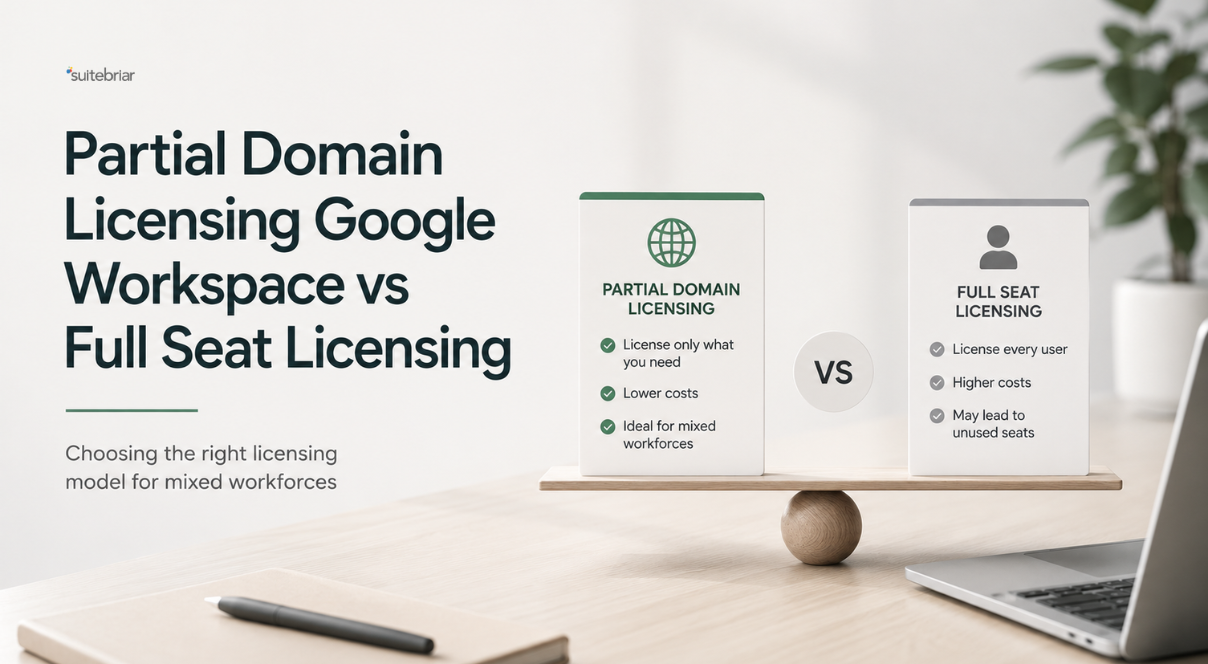
Partial Domain Licensing Google Workspace vs Full Seat Licensing for Mixed Workforces


The Licensing Problem Mixed Workforces Actually Face
A hospital system with 800 clinical staff and 200 administrative knowledge workers pays the same per-user rate for every account on its Google Workspace domain. A logistics company with 2,000 warehouse associates and 150 office employees does the same. In both cases, the vast majority of users log in for email, maybe a shared calendar, and little else, yet they carry the same license cost as the power users running Sheets models, building Slides decks, and living inside Shared Drives eight hours a day.
That mismatch adds up. At scale, it becomes one of the largest controllable line items in an organization's SaaS budget. The real question is which licensing model solves it without creating new problems in storage allocation, compliance coverage, or administrative complexity that cost more than the savings.
Comparison Criteria for This Decision
Four factors separate a licensing model that works for frontline-heavy organizations from one that merely looks cheaper on a spreadsheet: total licensing cost at scale, because the whole point of reconsidering the model is spend; feature access by user tier, since restricting the wrong capability for frontline users can break workflows that seemed unrelated to the license; administrative overhead, because managing two subscription lifecycles on one domain differs significantly from managing one, and the gap is wider than most admins expect; and compliance and audit coverage, particularly eDiscovery and Vault, where a gap you don't know about stays invisible until a legal hold forces it into view.
How Partial Domain Licensing Works in Google Workspace
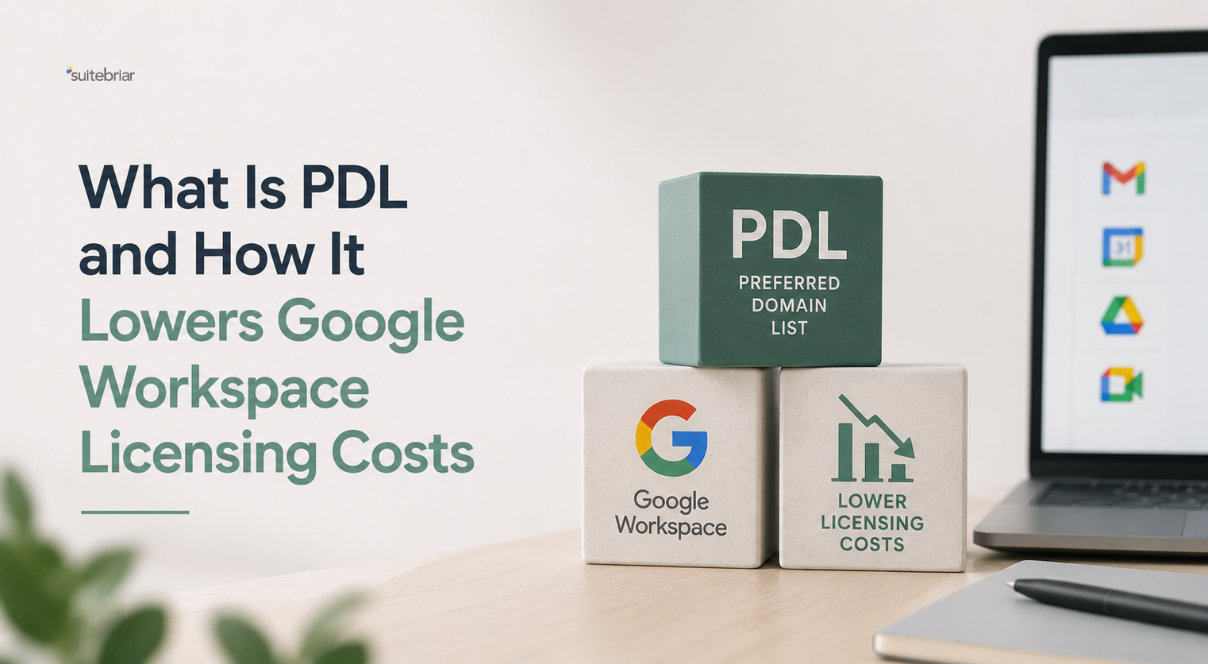
Partial domain licensing in Google Workspace lets a single domain run two or more Workspace editions simultaneously. Instead of applying one SKU to every user on the domain, the admin assigns different editions to specific organizational units or user groups. A corporate team might sit on Business Plus while a frontline group runs Business Starter, all under the same domain and the same admin console.
The mechanism hinges on what Google and its reseller ecosystem call a PDL product profile. When a partner enables partial domain licensing Google Workspace support, eligible SKUs are mapped into that profile, and each SKU carries its own subscription lifecycle for purchase, update, cancellation, and renewal. That last detail matters more than it sounds: these are distinct subscriptions with distinct rules, and the eligible SKUs are a defined list, not every edition Google sells. Organizations beginning this process benefit from working with a partner experienced in Google Workspace onboarding and migration to avoid misconfigurations at setup.
A common misconception is that PDL is just a billing convenience, a way to tag users for different invoice lines without any architectural consequence. Users outside the licensed group for a given edition don't simply inherit the features of the higher-tier SKU by virtue of sharing a domain. Storage pooling, Shared Drive access, and AI features are scoped to the licensed population, and the boundaries are enforced at the platform level, not just the billing level. Organizations that treat PDL as a cosmetic change discover the architectural reality after deployment, usually when a frontline user can't access a Shared Drive that was created under the higher-tier edition.
How Full Seat Licensing Works in Google Workspace
Full seat licensing is the baseline most organizations start with: one Workspace edition applied uniformly to every user on the domain. Every account gets the same feature set, the same storage pool contribution, and the same compliance tooling. There's a single subscription lifecycle to manage, one renewal date, one set of policies, and one audit surface.
The simplicity is real and worth naming. Policy enforcement is uniform, storage allocation is pooled across the entire user base without tier boundaries, and onboarding a new employee means assigning the same license everyone else has. The tradeoff is equally straightforward: every user pays the same rate regardless of whether they touch 5 percent of the suite or 95 percent of it.
Criterion 1: Total Licensing Cost at Scale
The cost case for PDL is intuitive. If 80 percent of a workforce needs only email and calendar, assigning those users a lower-tier SKU and reserving the higher-tier edition for knowledge workers reduces per-user spend on the majority of seats. For a 3,000-person organization where 2,400 users are frontline, the difference between a Starter-tier and a Plus-tier license across those seats adds up quickly, even before factoring in storage or add-on costs.
Full seat licensing charges the same rate across the board. The math is simpler, but the total is higher when most users are over-provisioned.
The catch with PDL is that the savings aren't guaranteed without an accurate user-tier audit up front. Misclassifying users, underestimating how many people actually need higher-tier features, or failing to account for seasonal headcount changes creates billing exposure mid-term. Under PDL subscription rules, adjusting seat counts or editions mid-cycle doesn't always behave the way a standard full-domain subscription adjustment would. An organization that budgets for 200 Business Plus seats and discovers it needs 350 may face a different pricing or contract outcome than it expected.
Criterion 2: Feature Access by User Tier
Under full seat licensing, every user has the same capabilities. A warehouse associate and a CFO can both create Shared Drives, contribute to pooled storage, and access whatever AI features the edition includes. Whether that access is used is a separate question, but it's available.
Under partial domain licensing, Google Workspace enforces real boundaries between tiers. Users on a lower-tier SKU don't automatically inherit Shared Drive access created under a higher-tier edition. Pooled storage is allocated based on the licensed population for each SKU, rather than aggregated across the entire domain. And Gemini AI features tied to editions don't extend to users outside that edition's licensed group.
The Shared Drive restriction is the one that catches organizations off guard most often. A team creates a Shared Drive under Business Plus, populates it with operational documents, and then a frontline manager on Business Starter tries to access it. Depending on the configuration and the editions involved, that access may be blocked or degraded. The exact behavior varies by edition pairing and by how the Shared Drive was provisioned, which makes it difficult to predict without testing in the specific environment. Community threads surface this question repeatedly, and the answers tend to be configuration-dependent rather than universal.
Storage allocation follows a similar pattern. Pooled storage under PDL is scoped to the users on each SKU, rather than shared across the domain the way it is under full seat licensing. An organization expecting the total storage pool to be available to all users will find that frontline users on a lower-tier SKU have a smaller allocation than anticipated.
Criterion 3: Administrative Overhead
Full seat licensing gives an admin one subscription to manage. Renewal is a single event, cancellation follows a single process, and policy enforcement is uniform. When headcount changes, the admin adjusts seat count on one subscription.
PDL multiplies that surface area. Each edition on the domain carries its own subscription lifecycle with distinct behaviors for purchase, update, cancellation, and renewal. The admin maintains organizational unit boundaries that determine which users get which edition, and those boundaries need to be audited whenever headcount shifts, departments reorganize, or seasonal workers cycle in and out. The subscription lifecycle stages under PDL don't behave identically to standard full-domain subscriptions, and admins who assume they do encounter unexpected outcomes at renewal or cancellation.
One failure mode worth naming: a partner or admin already managing a 24-month custom edition assumes that contract term carries automatically into a new PDL product profile. It may not. As AppDirect's documentation notes, custom editions with contract terms (example - 24 months, 36 months) may not be supported by Google. Partners selling those editions must explicitly add them to the PDL product profile, and discovering mid-term that the edition isn't supported creates a contract gap that's expensive to unwind.
Criterion 4: Compliance and Audit Coverage
Full seat licensing provides uniform Vault and eDiscovery coverage across the domain. Every user's data is subject to the same retention policies, the same legal hold capabilities, and the same audit scope. For organizations with regulatory obligations, that uniformity is the simplest way to demonstrate coverage. Organizations that need to verify their cloud security and compliance tooling should confirm that every SKU on the domain meets their regulatory requirements.
Under PDL, users on a lower-tier SKU may not be covered by Vault or eDiscovery at all, depending on which edition they're assigned. A Business Starter user, for example, doesn't carry the same Vault coverage as a Business Plus user. The gap is invisible during normal operations and surfaces only when a compliance team runs an audit or a legal hold is triggered and discovers that a subset of the workforce was never in scope.
The exact coverage boundaries vary by edition, and Google's documentation doesn't always make the tier-by-tier distinctions obvious in the context of a partially licensed domain. Organizations with regulatory obligations, whether HIPAA, FINRA, or internal data governance policies, should verify Vault and eDiscovery coverage for every SKU on the domain before deploying PDL.
What Happens to Unlicensed Users on a Partially Licensed Domain
On a partially licensed domain, users outside the higher-tier licensed group aren't unlicensed in the traditional sense. They still hold a license, just a lower-tier one. They can access the Google services included in their assigned SKU: email, calendar, basic Drive storage, and the core apps that come with that edition. What they lose is access to features, storage, and infrastructure scoped to the higher-tier edition.
Shared Drive visibility is the most common friction point. A user on a lower-tier SKU may not be able to access, or in some configurations even see, Shared Drives created under a higher-tier edition on the same domain. Pooled storage doesn't flow across edition boundaries, so a lower-tier user's available storage reflects only the pool contributed by users on that same SKU. Gemini AI features tied to a higher-tier edition are similarly scoped.
The exact behavior depends on the specific editions paired on the domain and on how organizational units are configured. Google's documentation doesn't publish a universal matrix of what each tier can and can't see on a PDL domain, which means the only reliable way to confirm behavior for a specific pairing is to test it in the target environment or work with a partner who has deployed that configuration before.
Verdicts by Use Case
For a large frontline workforce with low collaboration needs and no regulatory obligations across all users, PDL is likely the better fit. Assigning a lower-tier SKU to users who need only email and calendar produces real savings, and the Shared Drive and storage restrictions matter less when those users aren't expected to collaborate in Drive-heavy workflows.
For an organization with regulatory or eDiscovery requirements that apply to every employee, full seat licensing is the safer choice unless the PDL configuration uses Vault-eligible SKUs for all users. Mixing a Vault-covered edition with one that lacks coverage creates audit gaps that are difficult to justify to a regulator.
For a mixed workforce where frontline users genuinely need Shared Drive access alongside knowledge workers, full seat licensing or a higher-tier PDL SKU for the frontline group is the honest answer. Assigning a stripped-down SKU to users who need Shared Drive access defeats the purpose and generates support tickets that cost more than the license savings.
For an organization mid-domain-transfer or planning one, PDL license implications at transfer are a second-order risk that should be resolved before the transfer. Domain transfers can interact unpredictably with PDL subscription states, and untangling a licensing conflict during a migration is significantly harder than addressing it in the planning phase.
Choosing the right model depends on getting the user-tier audit right and understanding the architectural consequences before deployment. Suitebriar, a Google Cloud Premier Partner that has migrated over 5 million users to the cloud, works with organizations to scope these decisions before they become mid-contract surprises. If you're evaluating partial domain licensing Google Workspace options or reconsidering your current model, contact us to start with an honest assessment of what your workforce actually needs.