

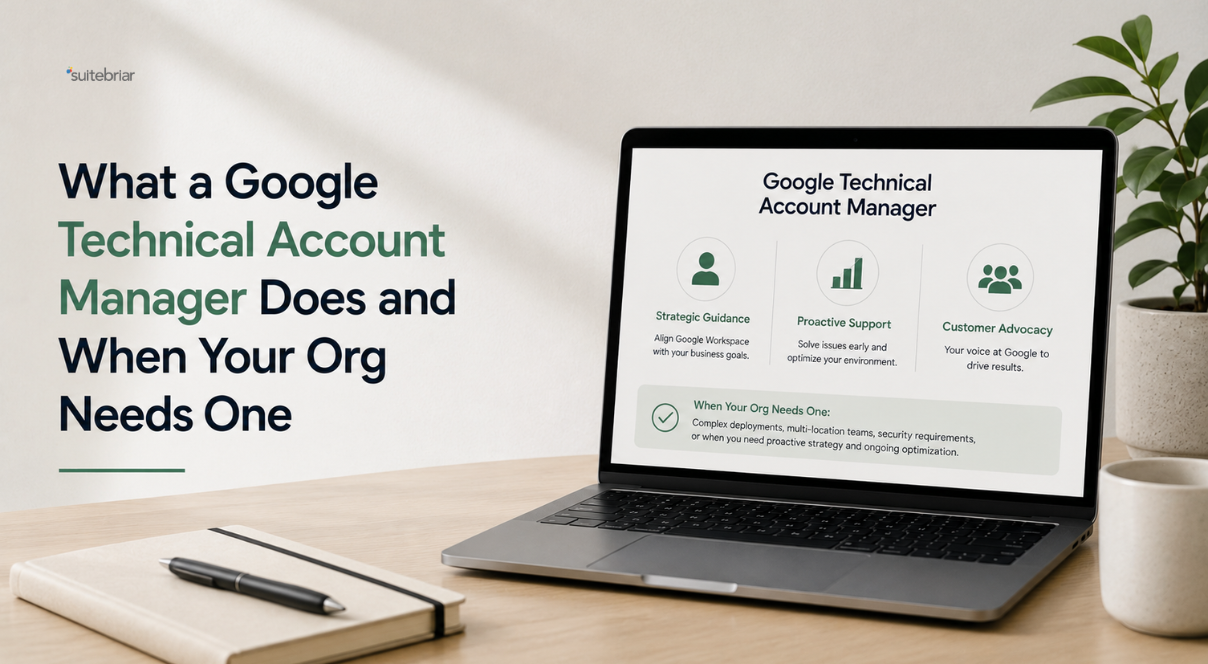
What a Google Technical Account Manager Does and When Your Org Needs One


Two Things Share the Name, and Conflating Them Costs You
The phrase "Google technical account manager" points to two genuinely different things depending on who's using it. One is a job title inside Google, a mid-level customer-facing role that requires at least five years of experience driving technical implementations or transformation programs. People searching for that title are usually evaluating a career move, and the Google Careers site lists the posting alongside minimum and preferred qualifications.
The other meaning is a paid service Google Cloud sells to enterprise customers. A Technical Account Manager, or TAM, is assigned to your organization as part of a premium support engagement, working proactively on your platform health, architecture, and operations over time. The two share a name and some overlapping skills, but they serve completely different audiences. If you're an IT leader trying to figure out whether your organization should engage a TAM, the career-path question ends here, and the service question begins. If you're researching the career path, the Google Careers listing is the better starting point.
What the Google Cloud TAM Service Actually Covers
A TAM engagement is a sustained, proactive relationship between your organization and a named Google Cloud engineer who learns your environment and works alongside your teams over months and years. Google frames the service around three pillars, and understanding what each one means in practice helps separate the TAM from other forms of technical help.
Platform health is the first pillar. The TAM helps set up and run your Google Cloud environment so it stays fully supported, meaning configurations are current, services are correctly provisioned, and nothing drifts into an unsupported state that would slow down a future support case. This work is less glamorous than architecture work, but it prevents the slow accumulation of technical debt that eventually turns into an outage.
Architectural stability is the second. Here the TAM provides guidance for architecting and deploying solutions that meet your performance and functional requirements. That guidance might look like a review of a proposed data pipeline before it goes live, or a recommendation to restructure how workloads are distributed across regions. The key word is guidance: the TAM advises on how something should be built, not whether your team should build it in the first place.
Operational rigor rounds out the framework. The TAM helps transform and modernize IT operations and operating models so the organization adds value rather than just keeping the lights on. In practice, this often means helping a team move from reactive firefighting to structured incident management, or establishing review cadences for cost optimization and capacity planning. Taken together, the three pillars describe an engagement that sits between your internal engineering team and Google's own product and support organizations, translating platform knowledge into decisions your team can act on. Organizations evaluating Google Cloud Platform consulting services will recognize this advisory layer as distinct from hands-on implementation.
Where a TAM Stops and a Partner Starts
The most common misunderstanding about a Google technical account manager is scope. A TAM advises, reviews, flags risk, and recommends architecture. A TAM doesn't execute the migration, build the deployment pipeline, run the change management program, or train your end users on new workflows.
That distinction matters because organizations often assume the TAM engagement will cover the hardest parts of a cloud transition: the actual moving of data, the reconfiguration of identity systems, the user adoption work that determines whether people actually use what's been deployed. Those responsibilities fall to internal teams or, more commonly, to a Google Cloud Premier Partner that handles migration and deployment work.
The relationship between a TAM and a partner is complementary. The TAM might identify that a particular workload architecture won't scale under projected load, and a partner takes that finding and does the engineering work to redesign and redeploy it. The TAM might recommend tighter IAM policies, and a partner configures them, tests them, and rolls them out across the organization. When both are in place, the TAM's recommendations actually get implemented. When only one is present, either the advice goes unacted on, or the execution happens without platform-level oversight.
Organizations that try to use a TAM as a substitute for a deployment partner tend to burn through the engagement's value quickly, collecting recommendations in slide decks that no one has the bandwidth to implement.
How Customers Actually Purchase TAM Access
Google doesn't list TAM pricing on a public rate card. The service is part of Google Cloud's premium support tiers, and access typically requires a direct conversation with a Google Cloud sales team or an authorized partner who can structure the engagement. A TAM is assigned to your account, meaning you work with a specific person who builds context about your environment over time rather than rotating through a support queue.
The specifics of SLAs, engagement hours, and escalation paths are negotiated as part of the support agreement, and they can vary based on the size and complexity of the account. Because the details aren't standardized in a way that's publicly documented, the most reliable path to accurate terms is a direct conversation with Google Cloud sales or with a Google Cloud Premier Partner who has visibility into current offerings and can help scope the engagement alongside other services, including cloud migration and cost comparison, that your organization may need.
The Org Size Where a Google TAM Starts Paying Off
No published spend threshold unlocks TAM eligibility, but the organizations that get the most from the engagement share a few observable conditions. The first is meaningful cloud complexity: multiple projects, cross-region deployments, production workloads with real uptime requirements, or a mix of services that interact in ways a single admin can't hold in their head.
The second is the presence of an internal team that can act on recommendations. A TAM produces architectural reviews, health assessments, and operational guidance. If there's no one on the other side to implement those recommendations, the engagement stalls. Organizations with a dedicated cloud operations function, even a small one, extract far more value than those still running cloud as a side responsibility for a general IT team.
The third condition is strategic commitment to Google Cloud as a long-term platform. TAM engagements are designed around sustained improvement. An organization still evaluating whether to stay on Google Cloud or migrate elsewhere won't get much from a relationship built around platform health and operational maturity.
In practice, the organizations that benefit most tend to be mid-market or enterprise, with enough infrastructure complexity that platform-level guidance saves real money and prevents real outages, but not so large that they've already built an internal team replicating everything the TAM would do.
What Organizations Get Wrong Before Engaging a TAM
Two failure modes come up repeatedly. The first is engaging a TAM before the organization has the internal capacity to act on what the TAM surfaces. The TAM delivers a health review that identifies fifteen configuration risks and three architectural improvements. The internal team, already stretched thin keeping production systems running, adds those findings to a backlog that never gets prioritized. Six months later, the same findings show up in the next review. The TAM's value depends entirely on the organization's ability to close the loop between recommendation and action.
The second failure mode is treating the TAM as a replacement for migration and deployment work. An organization signs up for TAM access while still in the middle of moving workloads to Google Cloud, expecting the TAM to guide the migration itself. The TAM's role is platform advisory, and the migration stalls because no one is doing the hands-on engineering; the TAM's architectural guidance can't land because the environment it's meant to improve doesn't fully exist yet. Organizations in active migration or deployment are almost always better served by engaging a partner for execution first and layering in a TAM once the environment is stable enough to benefit from ongoing oversight.
Questions Worth Asking Before You Commit
Before signing a TAM engagement, four questions help clarify whether the timing is right.
- Is your Google Cloud environment past initial deployment and running production workloads? If you're still migrating, the execution work needs to come first.
- Do you have at least one person internally who owns cloud operations and can act on architectural and health recommendations within a reasonable cycle?
- Have you already engaged a Google Cloud Premier Partner for implementation, or do you need one? A TAM and a partner solve different problems, and most organizations need both.
- Can you articulate what you want the TAM to improve? Platform reliability, cost efficiency, security posture, operational maturity, and generative AI and automation services are all valid focus areas, but "we need help with cloud" is too broad to get value from an advisory engagement.
If the answers point to an organization that's past the initial build, has internal ownership, and knows what it wants to optimize, a Google technical account manager engagement is likely worth the investment. If the answers reveal gaps in execution capacity or an environment still being stood up, the better first step is working with a partner who can handle migration, deployment, and adoption. Suitebriar, a Google Cloud Premier Partner that has migrated over five million users to the cloud, works alongside TAM engagements to make sure recommendations translate into real infrastructure changes. If you're trying to figure out the right sequence for your organization, get in touch.

.png?width=150&height=150&name=Blog%20Slide%20(1).png)
.png)

.png)