
Data Security Audit vs Continuous Monitoring for Google Workspace Admins


Two Approaches, One Workspace Tenant to Protect
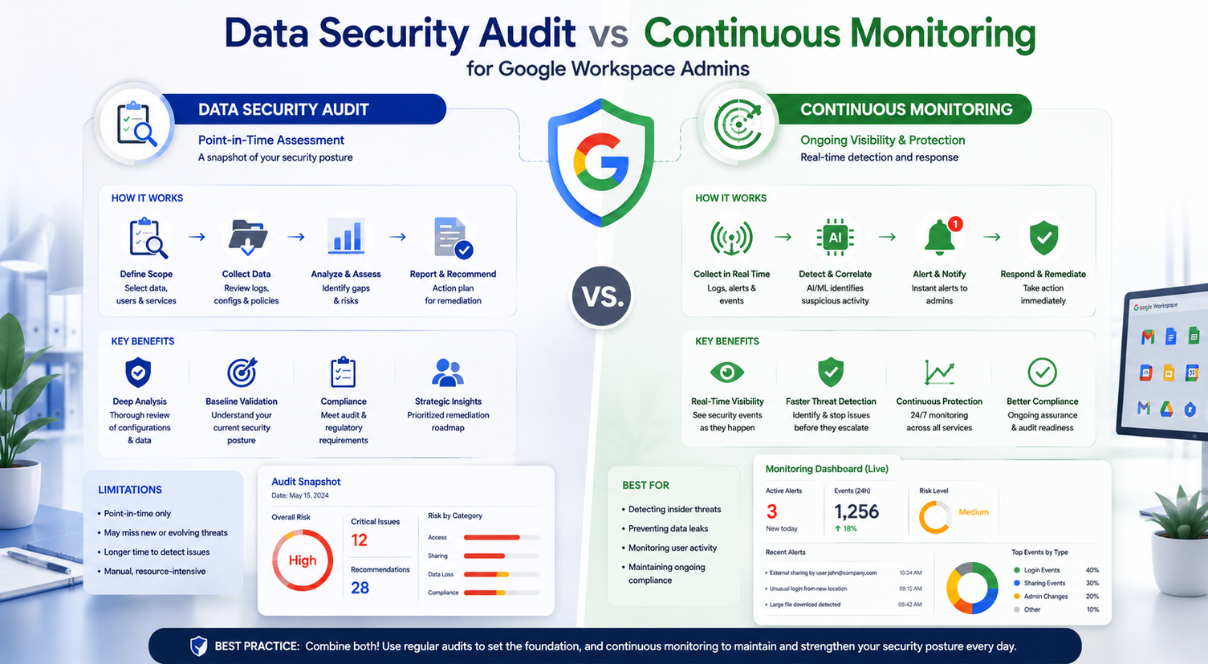
Google Workspace admins responsible for a production tenant face a recurring tension. A point-in-time data security audit produces a defensible record of how controls were configured on a specific date.
Still, that record starts aging the moment someone changes a sharing policy or grants a new OAuth scope. Continuous monitoring, on the other hand, catches configuration drift and anomalous events in near-real time, yet it doesn't produce the structured evidence that a compliance framework like SOC 2 or HIPAA actually demands.
They solve different problems. The practical question for a Workspace admin is which job each tool is built for and where the gaps sit when either one works alone.
Comparison Criteria That Matter to Workspace Admins
- Coverage completeness: how much of the tenant's attack surface does the approach actually examine or watch?
- Evidence durability for compliance: does the output satisfy an auditor's need for structured, dated documentation of control effectiveness?
- Response latency: how quickly does the approach surface a problem after it appears?
- Administrative overhead: how much preparation, tuning, or ongoing attention does the admin team need to invest?
- Cost-to-value ratio: does the spend scale reasonably with tenant size and risk profile?
Every approach looks strong on at least two of these and weak on at least one. The sections below evaluate each honestly so the comparison is useful rather than decorative.
What a Data Security Audit Actually Delivers in Workspace
On coverage completeness, a well-scoped audit is hard to beat. An auditor walks through sharing settings, Drive DLP rules, Admin console configurations, third-party OAuth grants, super admin role assignments, and organizational unit inheritance in a structured sequence. That methodical pass surfaces issues that require human judgment to interpret scope: an OAuth app that technically has read-only access but across every user's Drive, or a sharing default that was changed two OUs deep and never propagated the way the admin expected. Continuous tools can flag the event that created the misconfiguration, but they rarely have the context to assess whether the resulting exposure matters.
Evidence durability is the audit's clearest strength. The final report defines the organization's compliance posture and directs policy changes, and that document becomes part of the official compliance record. For teams preparing for SOC 2 Type II, HIPAA risk assessments, or similar frameworks, a structured data security audit report with dated findings, control-effectiveness narratives, and remediation recommendations is what the external reviewer actually asks for. Monitoring logs supplement that record but don't replace it.
The weaknesses are just as real. Response latency is zero during the audit window and infinite outside it. A misconfiguration introduced the week after the audit closes won't appear in the findings. Administrative overhead is significant: the admin team typically spends days gathering documentation, walking through configurations with the auditor, and triaging findings afterward. The findings often exceed a small team's capacity to remediate before the next audit cycle, which means the same issues reappear year after year. On cost-to-value, a thorough audit is worth the spend when compliance obligations require it, but for a tenant with no regulatory mandate, the ratio can be hard to justify annually.
What Continuous Monitoring Delivers in Workspace
Continuous monitoring earns its keep on response latency. Near-real-time alerting on admin role changes, external sharing events, login anomalies, and DLP policy violations means the admin team learns about a problem in minutes rather than months. Evidence staleness is low by definition because the signal is always current. For a Workspace tenant where the primary risk is configuration drift between formal reviews, monitoring is the practical floor.
Coverage completeness is narrower than it appears, though. Monitoring watches for events against a defined baseline, which means it's only as good as the rules and thresholds someone configured. A sharing policy that was misconfigured from day one won't trigger an alert because there's no change to detect. Alert fatigue is a genuine failure mode: automated signals generate false positives that distort risk prioritization, especially in tenants with heavy external collaboration where legitimate sharing events look indistinguishable from policy violations without context.
On evidence durability, monitoring logs are useful supplemental material, but they don't substitute for the structured control-effectiveness narrative that auditors require. A log showing that an alert fired and was acknowledged differs from a documented assessment of whether the underlying control is adequate. Administrative overhead is lower at the start but accumulates as the team tunes alert thresholds, investigates false positives, and maintains integrations. Cost-to-value varies considerably by tooling and tenant size and can't be determined without a proper assessment of the environment.
The Remediation Gap Neither Approach Closes on Its Own
The part that neither audits nor monitoring addresses is what happens after findings surface. An audit report lists findings, ranks them by severity, and recommends corrective actions, but it doesn't track whether those actions were completed. Continuous monitoring flags events and, in some configurations, auto-remediates simple violations, but it doesn't confirm that the underlying misconfiguration (the root cause) was actually corrected rather than just suppressed by a workaround.
Workspace admins can close this gap by pairing audit findings with a remediation register: a simple tracking document that records the finding, the assigned owner, a target remediation date, and the evidence of closure. That register becomes part of the compliance record and gives the next audit cycle a starting point instead of a blank slate. On the monitoring side, the practical move is to configure alerts that verify the specific controls the audit identified as weak. If the audit found that external sharing was enabled at the OU level for a department that shouldn't have it, the monitoring rule should watch for that specific setting being re-enabled after remediation.
This is where the hybrid model earns its place as a concrete workflow: the audit identifies the control gaps, the register tracks remediation, and monitoring watches for regression. Each piece does a job the others can't.
When an Out-of-Cycle Data Security Audit Is the Right Call
Annual cadence is a compliance convention, not a security strategy. Several Workspace-specific events should trigger an unscheduled audit, regardless of what monitoring catches. Adding a new domain or organizational unit changes the inheritance model for sharing and access policies. Completing a migration or large onboarding wave introduces users, data, and configurations that didn't exist when the baseline was set. Enabling a new Workspace edition or Gemini feature set expands the attack surface in ways that monitoring rules written for the old environment won't cover. A third-party app gaining broad OAuth scope deserves a structured review, not just an alert. A personnel change in the super admin role is a moment where trust assumptions shift, and a fresh audit of privilege assignments is warranted.
Monitoring alone doesn't substitute for a structured review at these inflection points because the baseline itself may have shifted. Monitoring watches for deviations from a known-good state, and after a migration or major configuration change, the known-good state hasn't been established yet. Organizations completing a Google Workspace onboarding and migration project should treat the post-migration audit as a required step rather than an optional follow-up.
Verdicts by Situation
Four common situations map cleanly to the five criteria, and the honest answer differs across them.
A regulated organization preparing for SOC 2 or HIPAA review needs the audit as the primary instrument. The compliance framework requires dated, structured documentation of control effectiveness, and monitoring logs alone won't satisfy the reviewer. Continuous monitoring is supplemental here: it fills the gap between audit cycles and provides evidence that controls remained effective after the audit date. The audit is the thing the framework actually asks for.
A mid-market Workspace tenant with limited IT staff faces a different calculus. Running a full annual audit may exceed the team's capacity, and the findings may sit unaddressed because there's no one to remediate them. For these organizations, continuous monitoring is the practical floor. It provides ongoing visibility without requiring the concentrated effort of a formal review. A lightweight annual audit, scoped to the highest-risk areas like external sharing, OAuth grants, and admin privileges, is the realistic ceiling. That's a defensible posture when there's no regulatory mandate for a comprehensive review.
An organization mid-migration or immediately post-onboarding should start with an out-of-cycle audit before trusting monitoring baselines. The environment is new, configurations may not match the design intent, and monitoring rules written against the old environment are unreliable. The audit establishes the known-good state that monitoring then protects. Teams working with a partner on Google Cloud Platform consulting should build this review into the project timeline rather than treating it as a separate engagement.
A mature security team with established monitoring and a track record of remediation is the one case where the hybrid model is genuinely appropriate. The audit validates what monitoring has been watching, monitoring catches what the audit misses between cycles, and the remediation register ties them together. For this team, the audit cadence can often shift from annual to event-driven, triggered by the inflection points described above rather than by the calendar.
Building the Right Security Posture for Your Workspace Tenant
The practical next step is matching your current situation to one of the four verdicts above. Start by confirming whether your compliance obligations require durable audit documentation or whether monitoring coverage is sufficient for your risk profile. Then assess whether your monitoring baseline is trustworthy: if the environment has changed significantly since it was established, the baseline needs to be re-validated through a structured review before you can rely on the alerts it generates.
Suitebriar, a Google Cloud Premier Partner that has supported security reviews across more than 1,000 organizations, works with Workspace admins to scope the right combination of audit and monitoring for their tenant. Whether the starting point is a post-migration security review, an annual compliance audit, or a monitoring baseline assessment, the conversation begins with the environment you actually have. Get in touch to start that conversation.
TLDR
Data security audits and continuous monitoring solve different problems for Google Workspace admins. Audits provide thorough, point-in-time coverage with structured, dated documentation that compliance frameworks like SOC 2 and HIPAA require, but they carry zero visibility between cycles and demand significant administrative effort. Continuous monitoring catches configuration drift and anomalies in near-real time but only detects deviations from an established baseline, and it doesn't produce the control-effectiveness narrative auditors need. Neither approach tracks whether findings actually get remediated, which is why pairing audit findings with a remediation register and targeted monitoring rules closes that gap. Certain events, like domain changes, migrations, new Workspace features, or a super admin change, should trigger an out-of-cycle audit regardless of monitoring coverage. The right combination depends on the organization: regulated companies need audits as the primary instrument, resource-limited teams should lean on monitoring, and mature security teams benefit most from the full hybrid model.