
Why Keyword Search Frustrates Employees and How Conversational Search Fixes It


The Daily Friction That Keyword Search Creates for Internal Users
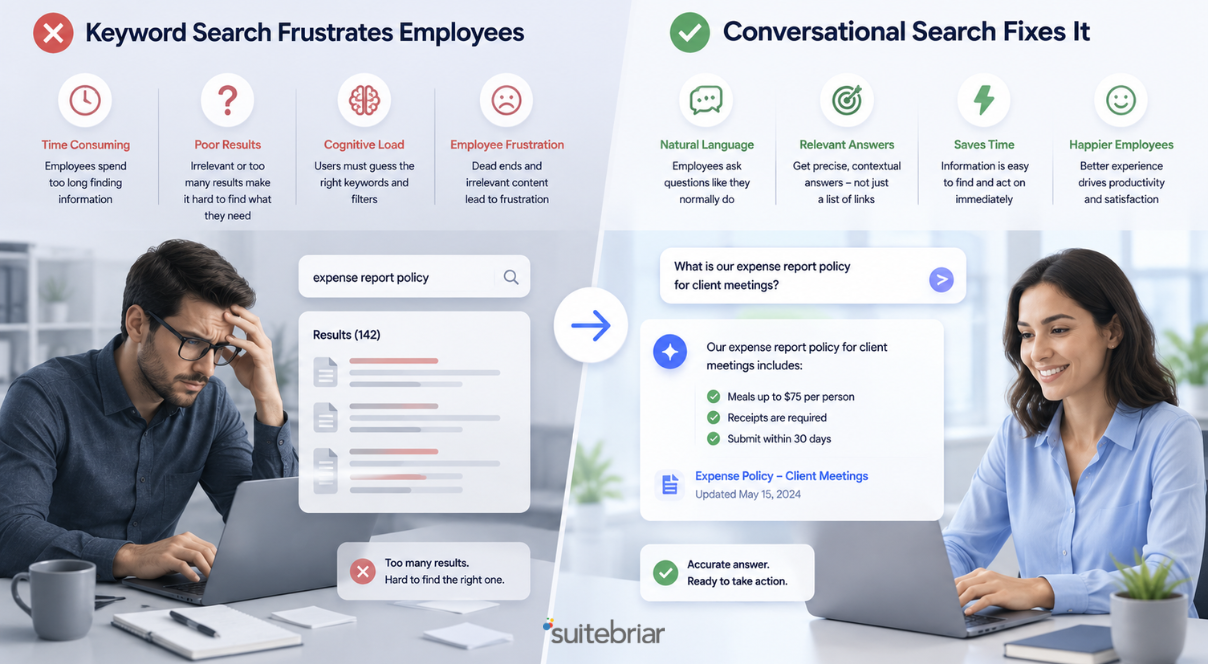
An employee needs to know whether the company's parental leave policy covers adoptive parents. She types "parental leave adoption" into the internal portal. She gets back a list of twelve documents: the full employee handbook, three revision memos, a benefits summary from 2019, and several HR announcements that happen to contain the word "adoption" in an unrelated context.
The answer exists somewhere in those files, but finding it means opening tabs, scanning headings, and hoping the right paragraph jumps out. Most people try two or three documents before giving up and pinging a colleague on chat.
The employee asked a reasonable question, and the system returned a ranked list of documents instead of an answer, which is exactly what keyword search is designed to do. The gap between what the person needed and what the tool delivered creates a quiet workflow tax that compounds across every team, every day. People reformulate queries, interrupt coworkers, or simply proceed with incomplete information. None of those outcomes show up in a dashboard, but all of them cost time and introduce risk.
The friction is worst for questions that span multiple documents or require context, things like "What's the deadline for submitting Q3 expenses if I'm on a client project in EMEA?" Keyword search can match individual terms, but it has no mechanism for assembling an answer from pieces scattered across a policy document, a regional supplement, and a finance FAQ.
Why Traditional Search Breaks Down on Real Work Questions
The most common cause of failure is deceptively simple: employees express intent, not terms. A person searching for "how to add a contractor to our insurance" is asking a procedural question, but the search index is matching the words "contractor" and "insurance" against every document that contains them. The result set is technically relevant and practically useless.
Another cause is that the answer often lives inside a document that never uses the searcher's exact phrasing. A benefits guide might describe the process under the heading "Extending Coverage to Non-Employee Workers" without ever using the word "contractor." Keyword indexes rely on term overlap, so a perfectly good source document stays buried because its vocabulary doesn't match the query.
A structural cause compounds the problem. Traditional search engines return relevance-ranked document lists. They are retrieval systems, not resolution systems. Even when the right document lands in position one, the employee still has to locate the relevant passage, interpret it in context, and decide whether it fully answers the question. That last mile of comprehension is manual labor the search tool was never built to handle.
Together, these causes create a pattern that most organizations recognize but misdiagnose. The instinct is to improve the search index, add synonyms, or retag documents. Those steps help at the margins, but they don't change the fundamental architecture: a system that returns documents when people want answers.
What Conversational Search Actually Does Differently
Conversational search replaces the document-list paradigm with a system that accepts natural language questions, retrieves relevant passages rather than whole files, and generates a synthesized answer grounded in those passages. The user asks a question in plain language, the system interprets the intent behind the query, retrieves the most relevant content chunks, and returns a direct response with citations to the source material.
A common misconception is that this is just a chatbot bolted onto existing search. Chatbots built on scripted decision trees can only handle questions they were explicitly programmed for. Conversational search, by contrast, works against an organization's full content corpus, using semantic understanding to match meaning rather than keywords. It handles the messy, compound questions that employees actually ask. Organizations exploring Gemini and generative AI solutions can see how these capabilities extend beyond search into broader workflow automation.
Multi-turn context retention is the feature that separates conversational search from a single-shot question-answering tool. When a user asks a follow-up, the system remembers what was discussed. If someone asks "What's the reimbursement limit for international travel?" and then follows with "Does that apply to contractors too?", the system understands that "that" refers to the reimbursement limit and "contractors" narrows the scope. Without conversation memory, every follow-up becomes a new, disconnected query.
Where does conversational search end and a RAG chatbot begin? In practice, the line is blurry, but the distinction matters. A retrieval-augmented generation chatbot uses a large language model to generate responses grounded in retrieved documents, which is the engine under the hood. Conversational search is the user-facing experience built on that engine: the natural language interface, the multi-turn memory, the citation layer, and the relevance pipeline that decides which passages to retrieve in the first place. The engine is necessary, but the search experience is what determines whether employees actually get answers.
Fixes That Work Before You Change Any Infrastructure
Before evaluating any platform, the cheapest intervention is improving the documents themselves. When content authors use clear headings, consistent terminology, and structured metadata, even a basic keyword index performs better. A policy document titled "Non-Employee Worker Benefits Extension Procedures" with an explicit metadata tag for "contractor insurance" closes the vocabulary gap that causes so many missed results.
A behavioral fix also helps. Most employees default to keyword fragments because that's what years of web search trained them to do. A short internal campaign showing people how to phrase queries as full questions, even on a keyword system, can improve result quality. The query "process add contractor insurance" returns different results than "How do I add a contractor to our insurance plan?" and on many modern search tools, the second version performs meaningfully better.
A diagnostic fix rounds out the low-cost options. Audit which content types generate the most reformulation loops. If employees consistently search, click, return, and search again around the same topics, those topics are candidates for dedicated FAQ pages or structured answer snippets. This kind of search log analysis doesn't require new technology, just someone willing to look at the data and act on it.
These fixes are genuinely useful and, for organizations with a manageable content corpus and a cooperative authoring culture, they may close most of the gap. Where they tend to fall short is in large, heterogeneous environments where thousands of documents are authored by dozens of teams with no shared style guide, and where the questions employees ask routinely span multiple sources.
When Conversational Search on Google Cloud Resolves What Simpler Fixes Cannot
For organizations that have already improved document hygiene and still find employees cycling through reformulation loops, the infrastructure itself needs to change. Google Cloud provides a conversational search capability through its Vertex AI Search platform, where Gemini-powered natural language understanding handles query interpretation, semantic retrieval pulls relevant passages from across an organization's content sources, and generated answers are grounded in those retrieved passages rather than fabricated from the model's training data. Organizations looking for Google Cloud Platform consulting services can work with a partner experienced in deploying these capabilities.
The practical difference shows up in multi-turn interactions. An employee can ask a question, get an answer with source citations, and then ask a follow-up that narrows or redirects the inquiry without losing context. The system maintains conversation memory across turns, so the second and third questions build on what came before rather than starting from scratch.
Grounded retrieval is the mechanism that keeps answers tethered to actual internal documents rather than general knowledge. This matters in enterprise settings where the correct answer to "What's our data retention policy?" depends entirely on what the organization has written, not on what an LLM learned during pretraining. Suitebriar, a Google Cloud Premier Partner that has migrated over 5 million users to the cloud, works with organizations deploying these capabilities on Google Cloud, handling the integration, connector configuration, and adoption work that determines whether the technology actually reaches employees.
The Failure Modes Conversational Search Can Still Produce
A system that generates authoritative-sounding answers introduces a new category of risk that keyword search never had. When a keyword search fails, the user knows it failed because the results are obviously wrong or irrelevant. When a conversational search system fails, the answer may read fluently and cite a real document while still misrepresenting what that document says. The LLM can paraphrase a passage in a way that subtly shifts its meaning, or it can stitch together fragments from two documents that contradict each other without flagging the conflict.
Stale retrieval indexes are another production reality. If the search pipeline ingests documents on a weekly schedule but a policy changed yesterday, the system will confidently return the old answer. Users who trust the tool won't think to verify, which makes stale indexes more dangerous in a conversational system than in a traditional one where the user was already doing their own verification by reading the source document.
Context memory that resets mid-session is a subtler failure. Some implementations lose conversation state after a timeout or when the system routes a follow-up to a different backend. The user experiences this as the system suddenly forgetting what they were talking about, which erodes trust quickly.
This is the default behavior of any system that lacks active governance: regular index refresh schedules, citation verification layers, and explicit handling of contradictory sources. The difference between a conversational search deployment that employees trust and one they abandon within weeks usually comes down to how seriously the team treats these operational details.
How to Measure Whether Conversational Search Is Actually Helping
Case deflection is the metric most vendors lead with, and the numbers can be impressive. Zoom reported a 31 percent decline in case submissions for every 1,000 search sessions after deploying conversational search capabilities, and Xero reported that more than one million queries each month don't turn into support tickets. Those are meaningful results, but deflection counts alone can mask a problem: a user who searched, got a bad answer, and gave up also counts as a deflected case. The ticket was never filed, but the question was never answered either.
More diagnostic signals exist. Query reformulation rate measures how often users rephrase the same question within a session, which is a direct indicator of whether the first answer was useful. Session depth tracks how many turns a conversation goes before the user leaves; very short sessions may indicate quick resolution or immediate abandonment, so this metric needs to be read alongside answer acceptance signals. Answer acceptance rate, where the interface includes a thumbs-up or "this helped" mechanism, gives the most direct feedback on whether the generated response actually resolved the question.
Follow-up question frequency is a subtler signal. A healthy conversational search deployment should show users asking follow-ups that narrow or extend the original question, which indicates they trust the system enough to continue the conversation. If follow-up rates are low and session depth is shallow, users are likely treating the tool as a single-shot search box, which means the multi-turn capability isn't delivering value.
A healthy adoption curve shows reformulation rates declining over the first few weeks as the system's retrieval pipeline is tuned, answer acceptance rates climbing as content gaps are filled, and follow-up frequency stabilizing at a level that reflects genuine conversational use. If reformulation rates stay flat or climb, the retrieval layer needs attention. If answer acceptance stays low despite good retrieval, the generation layer is the problem. Organizations evaluating or tuning a deployment on Google Cloud can contact Suitebriar to discuss onboarding, migration, and change management alongside what those signals look like in practice.
TLDR
Traditional keyword search returns lists of documents instead of direct answers, forcing employees to open multiple files, scan for relevant passages, and interpret context on their own. This breaks down especially when questions span multiple documents or use different wording than the source material. Conversational search addresses this by accepting natural language questions, retrieving relevant passages, and generating synthesized answers with citations. Multi-turn context retention lets the system understand follow-up questions without starting over each time. Before adopting new infrastructure, organizations can improve results through better document structure, training employees to ask full questions, and analyzing search logs for reformulation patterns. Google Cloud's Vertex AI Search offers conversational search grounded in an organization's own content. Conversational search introduces new risks, including fluent but inaccurate answers, stale indexes, and dropped context. Measuring success requires looking beyond case deflection to reformulation rates, session depth, and answer acceptance.


.png)