

Building Effective Technical Account Management Programs for Google Cloud Enterprise Deployments


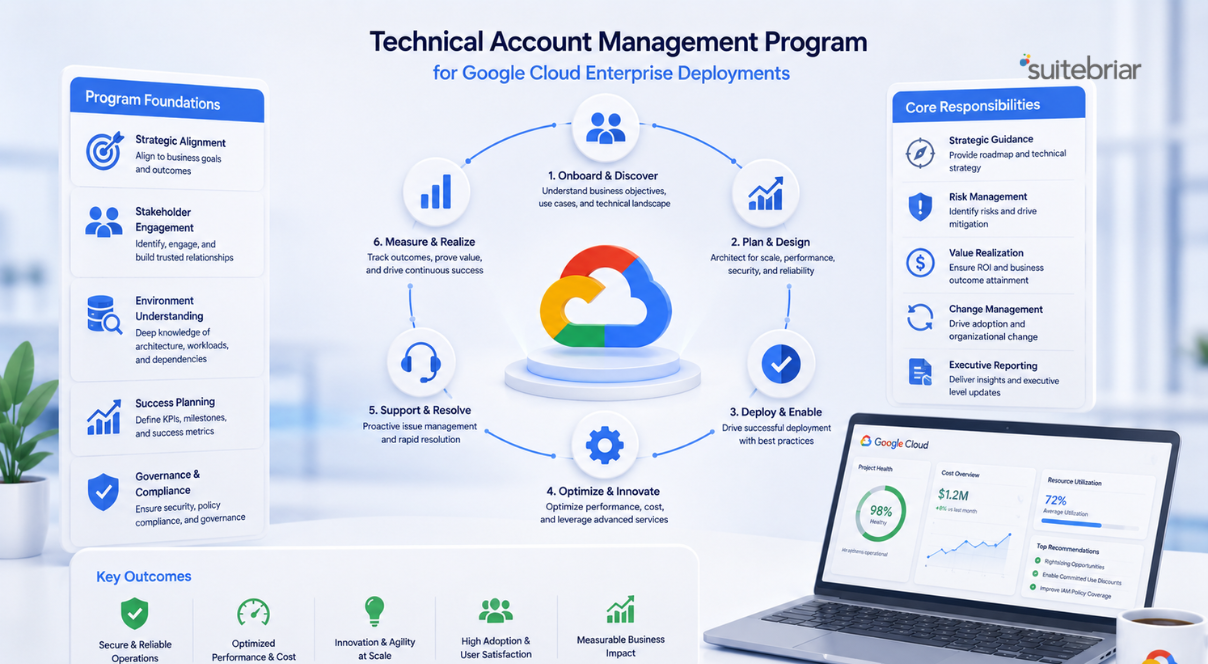
A Google Cloud technical account manager program is one of the most underrated investments an enterprise can make in its cloud strategy. The right Google Cloud technical account manager relationship turns a reactive support arrangement into a proactive partnership that anticipates issues, controls cost, and keeps the platform aligned with business priorities.
The wrong setup produces a generic point of contact who logs tickets and forwards them along. This article walks through what a high-functioning TAM program looks like, how to structure it for an enterprise-scale Google Cloud deployment, and how Suitebriar, a Google Cloud Premier Partner for over a decade, builds these programs for organizations that need more than break-fix support to succeed.
Why Enterprise Google Cloud Deployments Need a Dedicated TAM Layer
Enterprise Google Cloud environments rarely fail because the underlying platform is unreliable. They run into trouble because the customer side lacks the focused expertise to navigate the platform's depth, configure it correctly, and adapt as new services launch. Generic support handles tickets after problems occur. A dedicated technical account manager helps prevent those problems from materializing in the first place.
The reasons most often cited by enterprise cloud leaders fall into three buckets. The first is roadmap visibility. Google Cloud ships new services and feature updates constantly, and internal teams cannot reasonably track every change. The second is cost drift. Without active oversight, monthly bills creep upward as developers spin up resources that get forgotten. The third is adoption stalls, where workloads migrate to the cloud but teams continue to operate them the way they ran on-premises, leaving most of the platform's value untapped.
Suitebriar's technical account management (TAM) for the Google program addresses all three. The team builds technical knowledge across the platform to offer expert advice, proactively guide adoption, and review usage and consumption to keep cost and architecture decisions on track. This is the difference between hiring a contractor to fix a broken pipe and retaining an architect who keeps the whole plumbing system running correctly through every renovation.
Core Components of a High-Functioning TAM Program
A TAM program that delivers measurable value rests on a handful of operational components. Each one is straightforward in isolation. The discipline lies in running all of them together as a coordinated cadence rather than treating them as separate activities.
Proactive Guidance and Roadmap Overviews
A strong TAM does not wait for the customer to ask. Suitebriar TAMs deliver demonstrations and admin training, review usage and consumption, and provide product roadmap overviews so internal teams know what is coming before it ships. This kind of forward-looking communication lets enterprises plan around new features rather than scrambling to adopt them after the fact.
Usage and Consumption Reviews
Cloud spend grows fastest when nobody is watching. Regular usage reviews surface anomalies, idle resources, and rightsizing opportunities that protect the budget without slowing engineering teams down. This work pairs naturally with broader Google Cloud cost optimization efforts and feeds the financial reporting that finance leaders need each quarter.
Escalation Paths Into Google
Even the best in-house team eventually needs a direct line into Google's engineering side. As a Google Cloud Premier Partner, Suitebriar maintains direct escalation lines to senior members of Google's customer service team, which means complex issues reach the right experts quickly rather than getting passed through tiers of generic support.
These three components reinforce each other in practice. Proactive guidance often surfaces the questions that benefit from a usage review, and usage reviews occasionally reveal a platform anomaly that benefits from direct Google escalation. When all three components are running, the customer experiences the TAM as a single relationship rather than a collection of services, and the partner can pattern-match across the full engagement rather than only seeing the slice of work in front of them at any moment.
Structuring the TAM Engagement for Enterprise Scale
Enterprise deployments need a TAM model that scales with them. A single TAM working with a 50-user startup is fine. A 5,000-employee organization with multiple business units and regulatory obligations needs a program designed to handle that complexity without losing the personal accountability that makes the role valuable in the first place.
The structure usually involves a primary TAM as the lead relationship owner, supported by specialists who cover specific platform areas such as data, security, networking, and AI. Suitebriar's broader managed services & premium support for Google Cloud offering bundles Customer Success with Technical Support, which means enterprises get both strategic relationship management and the ability to resolve hands-on issues without juggling separate contracts. Bundling matters because adoption problems and support problems often turn out to be the same problem viewed from different angles.
Cadence is equally important. Quarterly business reviews keep leadership aligned on the roadmap, spending, and risk. Monthly operational reviews surface trends in tickets, usage patterns, and adoption metrics. Weekly working sessions handle in-flight projects and architectural decisions. This rhythm gives every stakeholder a predictable touchpoint and prevents the TAM relationship from drifting into a reactive mode where it only activates when something breaks.
Connecting TAM Outcomes to Business Metrics
A TAM program needs to justify itself to finance and executive leadership the same way any other line item does. Measuring the right outcomes is what separates a program that gets renewed year after year from one that gets cut during the next budget cycle.
The most defensible TAM metrics tie directly to operational and financial impact. Cost savings from optimization recommendations are the easiest to quantify. Reduced incident resolution time is the second clearest measure. Adoption metrics, such as the percentage of licensed features actually being used, capture the harder-to-see value of moving an organization from minimal use of the platform to full engagement. When enterprises pair Google Cloud consulting services with a TAM relationship, the TAM also becomes the steward of decisions made during the original consulting engagement, ensuring that architectural choices remain valid as the platform evolves.
Beyond hard metrics, leadership values the qualitative signal of having a trusted advisor who knows the environment. When a senior executive asks a question that crosses platform boundaries, the TAM can answer based on direct knowledge of the customer's setup rather than starting from a blank slate. That accumulated context is hard to put on a spreadsheet, but it is often the single biggest reason organizations keep TAM programs in place long term.
A practical way to capture this value is to maintain a running log of decisions the TAM has shaped during the year. Architectural choices avoided, configuration changes prevented, and migrations accelerated all belong in that log. Reviewing it at renewal time turns the conversation away from a generic cost discussion and toward a concrete record of work that mattered. Customers who do this well rarely face hard questions about the program's value because the evidence sits in front of them in writing.
Common Pitfalls and How to Avoid Them
TAM programs fail in predictable ways. Understanding the failure modes upfront helps internal teams structure the engagement so it produces value rather than overhead.
The first pitfall is treating the TAM as a glorified ticket router. If the program reduces to forwarding cases between the customer and Google, it has lost its purpose. The TAM should be solving problems and shaping decisions, not relaying messages. The second is failing to give the TAM enough access to the environment. A TAM without visibility into the customer's organization unit structure, billing accounts, and IAM policies cannot give meaningful advice, no matter how skilled they are.
The third pitfall is misalignment of outcomes. If the customer expects a TAM to manage migrations end-to-end while the partner expects to advise rather than execute, the engagement will frustrate everyone within a quarter. Set the scope explicitly at the start. Suitebriar's broader Google Cloud managed services practice exists precisely to handle the execution work that sits outside a strategic TAM role, so customers can choose how much they want delivered by the partner versus retained in-house. The fourth pitfall is underinvesting in change management. The technical work is only half the equation. Teams have to actually use the platform differently for the value to land, and the TAM should be helping drive that behavioral shift rather than leaving it to chance.
Key Takeaways
- Enterprise Google Cloud deployments need a dedicated TAM layer to handle roadmap visibility, cost drift, and adoption stalls that generic support cannot address.
- High-functioning TAM programs combine proactive guidance, usage reviews, direct Google escalation paths, and a predictable meeting cadence.
- For enterprise scale, structure the engagement with a primary TAM, specialist support, and bundled premium services so adoption and support work move together.
- Tie TAM outcomes to cost savings, incident resolution, and feature adoption so the program defends its budget every cycle.
- Avoid common pitfalls by defining scope upfront, giving the TAM real access to the environment, and pairing technical work with active change management.
- Ready to build or rebuild your TAM program for Google Cloud? Reach out to Suitebriar to discuss what a Premier Partner TAM relationship could look like for your organization.
TLDR
A Google Cloud technical account manager program is what turns reactive support into proactive value for enterprise deployments. The right structure pairs a primary TAM with specialists, runs a steady cadence of strategic and operational reviews, ties outcomes to cost and adoption metrics, and connects directly into Google when issues need to escalate. Suitebriar has built these programs for more than 1,000 organizations as a Google Cloud Premier Partner with over a decade of premier status. To explore what a TAM relationship could look like for your deployment, contact the Suitebriar team to start the conversation.

.png)
